The Brothers Who Bet the Farm on Regenerative Agriculture – And Won
Tyler Lee will tell you that everything starts with the soil. Healthy soil produces healthy crops, healthy crops produce healthy animals, and healthy animals produce food that nourishes the people who eat it. It sounds simple. Most true things do. But building a farm, and a life, around that conviction took a choice.
Back to the Beginning
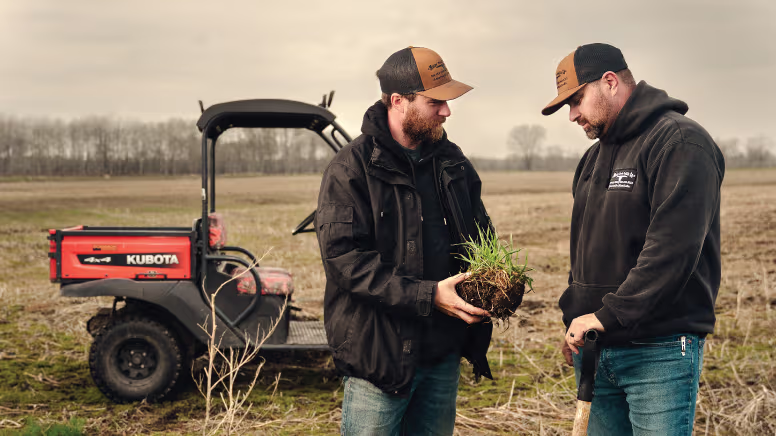
Mossy Rock sits on the west side of Lake Manitoba, four minutes from the beach, surrounded by trees, wildlife, and the kind of flat, quiet land that gets into a person. Tyler and Josh’s grandfather had built it. So, when Tyler and Josh had the chance to buy the 1,600 acres from him, they didn't hesitate - but for Tyler, that didn't mean he was ready to leave the life he'd built elsewhere.
He was a career firefighter working out of Portage la Prairie. His wife Katelynn had her own career there. The city was comfortable, and comfortable felt like enough. Every holiday, every day off, Tyler found himself back at Mossy Rock anyway - but he told himself that was just what you did. The farm was always there. So was his other life.
Meanwhile, Josh was already on the land full-time, working through the operation year after year, pushing through the hard soil and the rocks and the limitations of conventional farming until he came to a conclusion: The whole approach needed to change. Tyler trusted his brother, and in 2019, that trust became a decision.
“My favourite thing about working with my brother is that we get to do the same thing both love most – farming, working with the cattle, being around the equipment,” says Josh. “And taking something our grandfather started and expanding on it. When we tell him things are working well, his face just lights up. He gets ecstatic.”
Mossy Rock sold most of the big tillage equipment on the property, only keeping smaller pieces for levelling out ruts or rough spots. They went all in on regenerative agriculture - planting polyculture mixes of up to 13 species at a time, letting legumes pull nitrogen directly from the atmosphere and fix it into the soil, allowing the land to work the way land is actually built to work. Every year since, they've used less chemicals. Every year, the soil gets a little healthier.
Regenerative agriculture demands equipment that works with the soil rather than against it, and the right combination matters. Their Great Plains 1206NT no-till drill, pulled by a Kubota M4, makes a small slit in the ground, drops the seed, and leaves the microbiology undisturbed - turning what used to be multiple tillage passes, harrowing, stone-picking, and rolling into a single finished seeding pass. The fuel savings alone shifted the economics of the whole operation.
"It just sips the fuel," Tyler says. "Our hired hand Colt went out for a full day picking bales and hauling trailers. Next morning the tank was still three-quarters full. I said, don't fill it - we can go four more days on that."
Two Lives, One Too Many
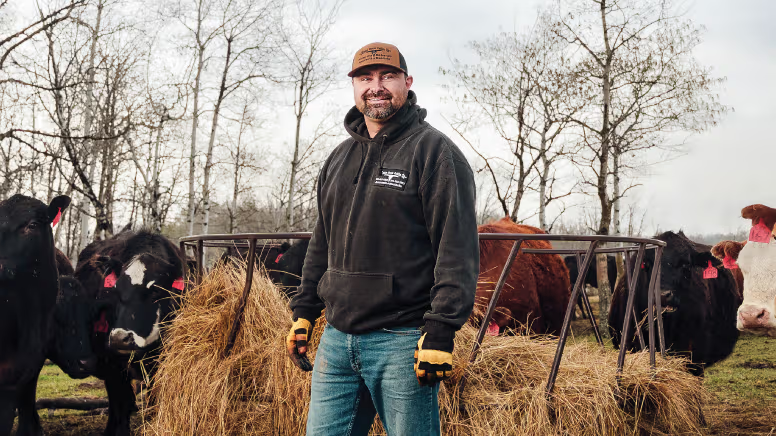
The farm was changing, the soil was recovering, and the numbers were starting to move - but Tyler was still splitting himself in two. Then a serious car accident forced a harder question: why was his family still in the city at all? They moved their house onto the yard and Katelynn began working from home. Tyler kept driving to his shifts, but the distance between his two lives had started to close.
Then he got sick and he was forced off work. An older firefighter named Wendell had warned him years before: ten years in this job and it starts costing you more than it gives back. Tyler was living that warning from the window, watching the operation he and Josh had built keep growing without him.
When he finally felt well enough to get outside again - to be with the cattle, to move through the land - the answer was already there.
"The farm had grown," he says. "I wasn't going back."
That was four years ago.
What They Built
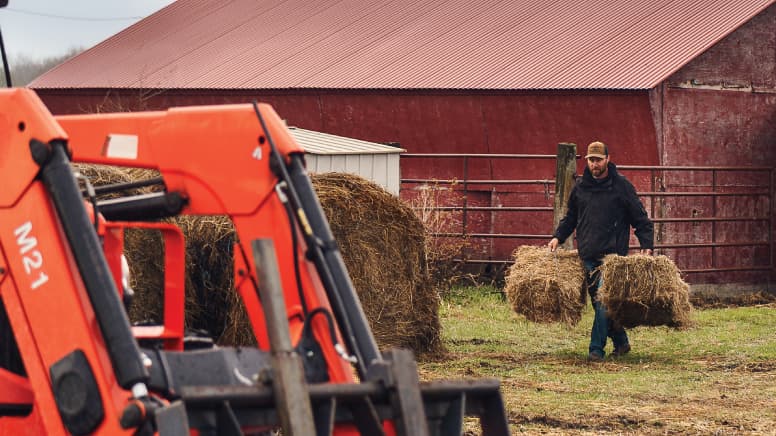
What Tyler returned to full-time was an operation that had outgrown its origins in the best possible way. He calls the equipment lineup their Kubota arsenal, and the name fits.
The M135X handles the heavy work - clearing field access through Manitoba winters and pulling the DMC 8540T disc mower through polyculture crops that grow 16 and 17 feet tall. Every other mower they've put to that crop has fallen short, competing machines are too slow through the standing stalks to make it economical. For them, the 8540T isn't a preference - it's what makes harvesting those polyculture stands possible at all.
"The tractor doesn't even flinch," Tyler says.
Harvesting those crops as silage requires individual bale wrapping - a job that belongs to the Kubota WR1400. Without it, bales would need to be tube-wrapped and left in the field through a Manitoba winter, making them immovable and difficult to sell. The WR1400 wraps each bale individually so they can be transported, stored, and shipped across the country without losing quality. The brothers are direct about what that means: without it, that entire part of the business doesn't exist.
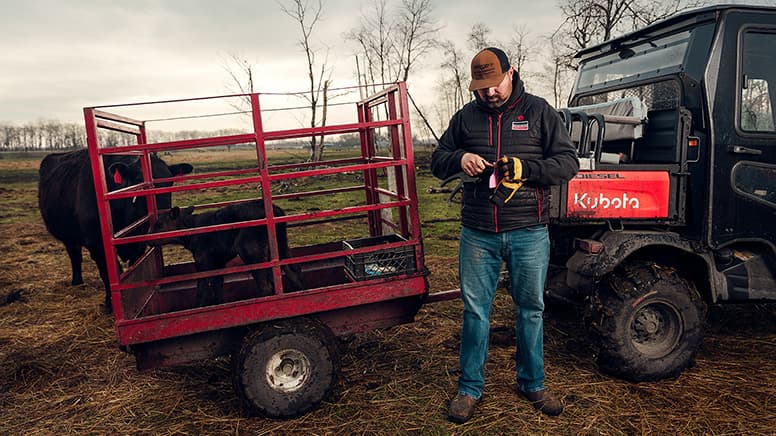
Then there is the quieter side of the fleet - the RTVs that tell the story of three generations living and working on the same land. The RTV- XG850 Sidekick with the Nordic package and cabin heat is Josh's machine for checking pasture and navigating side roads in real Manitoba weather, and during calving season it's running constantly - moving calves, covering ground, keeping the operation connected across 3,680 acres of pastureland. The X1140, with tracks on in winter and a full cab and heat, moves people across the property any time of year. The RTV400 helps with some yard run about. And the RTV520 belongs to their grandfather - 92 years old, still living in the farmhouse across the yard.
"When he wants to go to the barn, he gets in the 520 and away he goes," Tyler says. "We don't have to worry about whether he'll get there and back. It just works."
The ranch is also a place people are invited into. Farm tours bring visitors out to walk the land, understand the practices, and sometimes meet a cow for the first time - many of them arriving on a hay rack pulled by the same M7040 that started it all.
The Mission That Holds It Together
Tyler doesn't talk about Mossy Rock like a business looking for an edge. He has watched people he loves struggle with their health. He has felt it himself. He draws a straight line from what has happened to the nutrient density of the modern food supply to what has happened to the soil that produces it - and he farms like that line matters.
Mossy Rock sells direct to consumers, runs farm tours, and prices their beef in line with the grocery store - not because the margins work out neatly, but because the point was never to extract a premium.
"The money matters - we need it to keep going," Tyler says. "But that's not the point. The point is that people deserve to eat food that's actually healthy, and someone has to grow it that way."
Their dealership, Lawson Sales, has been part of the growth. Dylan Webber, now general manager, was the sales rep who saw what Mossy Rock was building early and went to Kubota on their behalf to make the 8540T and WR1400 possible. The relationship hasn't changed as the operation has expanded - when they need something, or when something gets wrecked, one of them picks up the phone and it’s ready.
The M7040, the first Kubota Mossy Rock ever bought in 2012, is still on the property. Still running. They can see it out the window.
"Just the fact that we still have that tractor here," Tyler says, "is the whole story right there."
Mossy Rock Cattle Company is a family-operated regenerative cattle ranch located on the west side of Lake Manitoba, Manitoba. Founded by Tyler and Josh Lee on land purchased from their grandfather, the operation spans approximately 5,200 acres and practices no-till seeding, polyculture planting, and rotational grazing. Mossy Rock raises and direct-markets regeneratively raised beef to consumers across Canada.